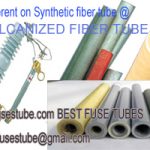
Vulcanized fiber tubes, often combined with epoxy fiberglass, are a workhorse of power protection. They insulate, quench arcs, and survive the mechanical shock of fault interruption in high-voltage current limiters, drop fuses, and fuse cutouts. This guide explains what they are, why engineers specify them, and how to use them. […]
Continue readingTag Archives: Fuse Tubes
Fiber Tubing, Grey, Red, Black, White ,Vulcanized Fiber Tubes, Vulcanised Fibre Tubes, Fuse Tubes,
Vulcanized fiber tubing, also spelled vulcanised fibre tubing, is a dense, rigid insulating material with good physical and mechanical properties, dielectric strength, arc resistance, and arc-quenching behavior. It has been a standard choice for fuse tubes and high-voltage cutout liners for decades, and it is still the reference material that […]
Continue readingHow different Insulating Kraft Paper Sleeves -a spiral or convolute winding paper tube and vulcanized fiber tube?
Two insulating tubes are often compared for motor and transformer service: the spiral or convolute wound kraft paper tube and the vulcanized fiber (hardened fiber) tube. They look similar in a catalog but are made very differently, and that difference decides where each one belongs. How Each Tube Is Made […]
Continue readingWhat is the difference between the epoxy glass fiber wound tube and epoxy glass canvas tube?
Epoxy glass fiber wound pipe and epoxy glass canvas (cloth) tube are both epoxy fiberglass insulators, but the construction method and properties differ. This article compares them across the properties that decide a specification, so you can choose the right tube for electronics, electrical, or mechanical duty. How the Two […]
Continue readingWhat is a Fusible Link? how applied fuse links?
A fusible link is a short piece of insulated low-voltage cable within an automotive wiring harness, designed to protect the harness where a conventional fuse is unsuitable. This article explains what a fusible link is, how it is applied, and how it is sized and coordinated with the other overcurrent […]
Continue readingEV/HEV High Voltage Fuses Future Challenges
The shift to electrified vehicles is expanding the fuse market, but it is also making fuse application harder. Higher voltages, faster charging, and tighter system integration are pushing fuses past the limits of existing standards and component-only thinking. This guide covers the challenges EV and HEV fuse buyers should plan […]
Continue readingEV/HEV High Voltage Fuse Applications
Selecting a high-voltage fuse for an electric vehicle or hybrid platform is a different exercise from picking an industrial fuse off a catalog page. The circuit runs on DC, the load swings with every acceleration and regen event, and the fuse sits next to the most expensive hardware on the […]
Continue readingCharacteristics and use of fuses
A fuse is the simplest protective device in an electrical system, and still one of the most reliable. It carries normal current indefinitely, then opens the circuit when current rises above a set value for a set time. Because the element melts from its own heat, a fuse needs no […]
Continue readingFuse arc extinguishing measures on Fuse cutouts
When a fuse element melts, an arc forms at the break. Metal vapor from the melting element intensifies the arc and makes it burn harder, so the design goal is to extinguish it as quickly as possible. Understanding why the arc persists, and what actually puts it out, is the […]
Continue readingFuse tube apply
A fuse tube is the housing that carries the fuse element and, in expulsion designs, actively clears the arc. It is an electrical component installed in a circuit to keep operation safe, and its role changes with the application. This article explains what the fuse does, how aging affects it, […]
Continue reading